State of Georgia Small Business Guide
Services
Content Development | Copywriting | Instructional Writing | Design
In an effort to support prospective small business owners in Georgia, the governor’s office enlisted the Office of Planning and Budget and my team at Digital Services Georgia to create the first public statewide resource to guide new owners through starting a business for the first time.
The Challenge
If you want to start a new business in Georgia, you’ll have to interact with at least a half a dozen agencies on the state and municipal level, in a specific order. At each agency you’ll need some combination of the right documentation, personal information, financial accounts, and fees. Many times you’ll only find out what you need once you’ve gotten to the agency and been told you’re missing a critical step you should’ve taken at another agency first.
While constituents view state government like a big company with many departments who all know each other, share data, and can access the same systems, the reality is far more siloed. All of these agencies are experts at what they do, but they don’t know how the process works at other agencies. The Secretary of State’s office may know you have to register your new business with the Department of Revenue, but they may not know when or how to go about it. Break it down by type of business and location in the state and it gets even more complicated.
Larger organizations or investors can hire private attorneys and companies that specialize in setting up new business entities. But what about the average person with a great idea and few resources? The State of Georgia had no comprehensive guide to walk them through the process.
The Strategy
In our initial meetings with the Georgia Office of Planning and Budget (OPB), they wanted to create a “wizard”, as a few other states had done, that would spit out what type of entity an owner needed to create and the steps involved to do so.
After testing out and picking apart the few states they sent us as examples, several problems became immediately apparent. First, the state couldn’t be seen as giving anything that could be construed as legal advice, so we had to be very careful about what we said and how it was presented. More importantly, these “wizards” were really not much more than puffed-up webforms with a bunch of conditional logic. Sure, we could build our own, but it wouldn’t be terribly useful. The information can be complicated, is extremely situation-dependent, and requires context and space to explain.
A wizard didn’t allow for that, so the information would have to be so watered down as to be almost useless. Further, it didn’t outline the information in a step-by-step guide a user could easily follow, save, and refer back to. As we found out, figuring out the business entity someone needs and getting it registered is only one step in a much larger process.
I sat down with our head of operations and laid this all out. We played with various webform options using conditional logic, and she saw the limitations I outlined. I proposed a solution we could pitch to the OPB team: a comprehensive guide on the state’s official website, using a new content type within our Drupal-based CMS, GovHub, that we could customize to our needs, but would also fit within the site’s existing architecture.
Once we showed the team wireframes of what the end result could look like and got their buy-in, the real work began. We held hours-long, in-person meetings with key subject matter experts from the Secretary of State’s office, the Department of Labor, and the Department of Revenue. I followed up with attorneys and specialists at each agency when I had process questions. I called agency customer service reps to verify what they actually ask constituents to do. I searched for resources on the municipal and federal level to see what else would be available to a small business owner.
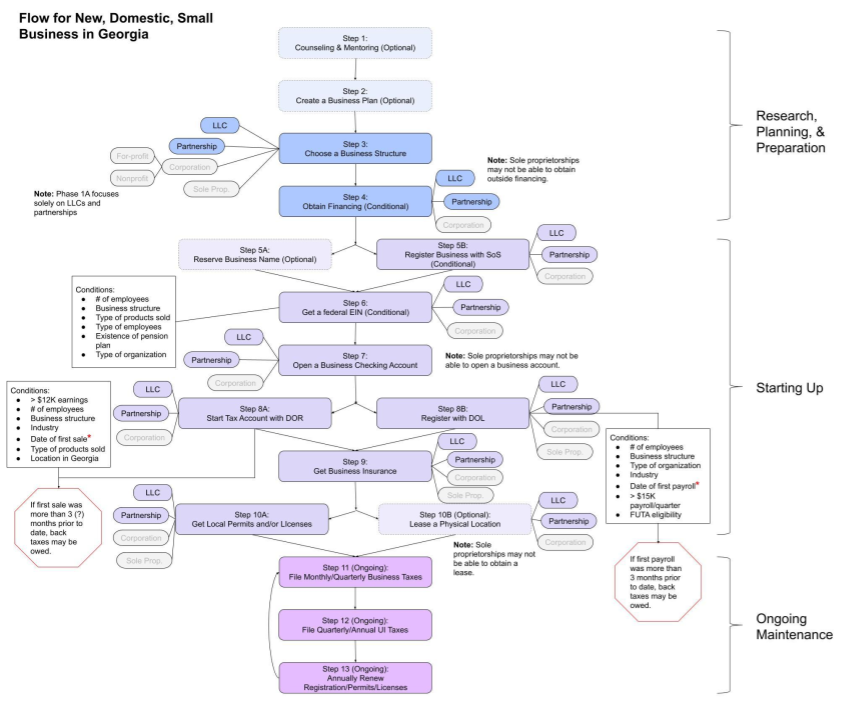
I developed a process flow chart that mapped the full life cycle of starting, maintaining, and winding down a small business in Georgia (you can see a sample in the photos below). This would be the outline we followed to develop the design and content of the guide. I worked with our design and development teams to sketch out what I had in mind and figure out together how we could make it work on GovHub. I wrote and refined the content with our internal team and sent it to each agency to review for accuracy.
The Results
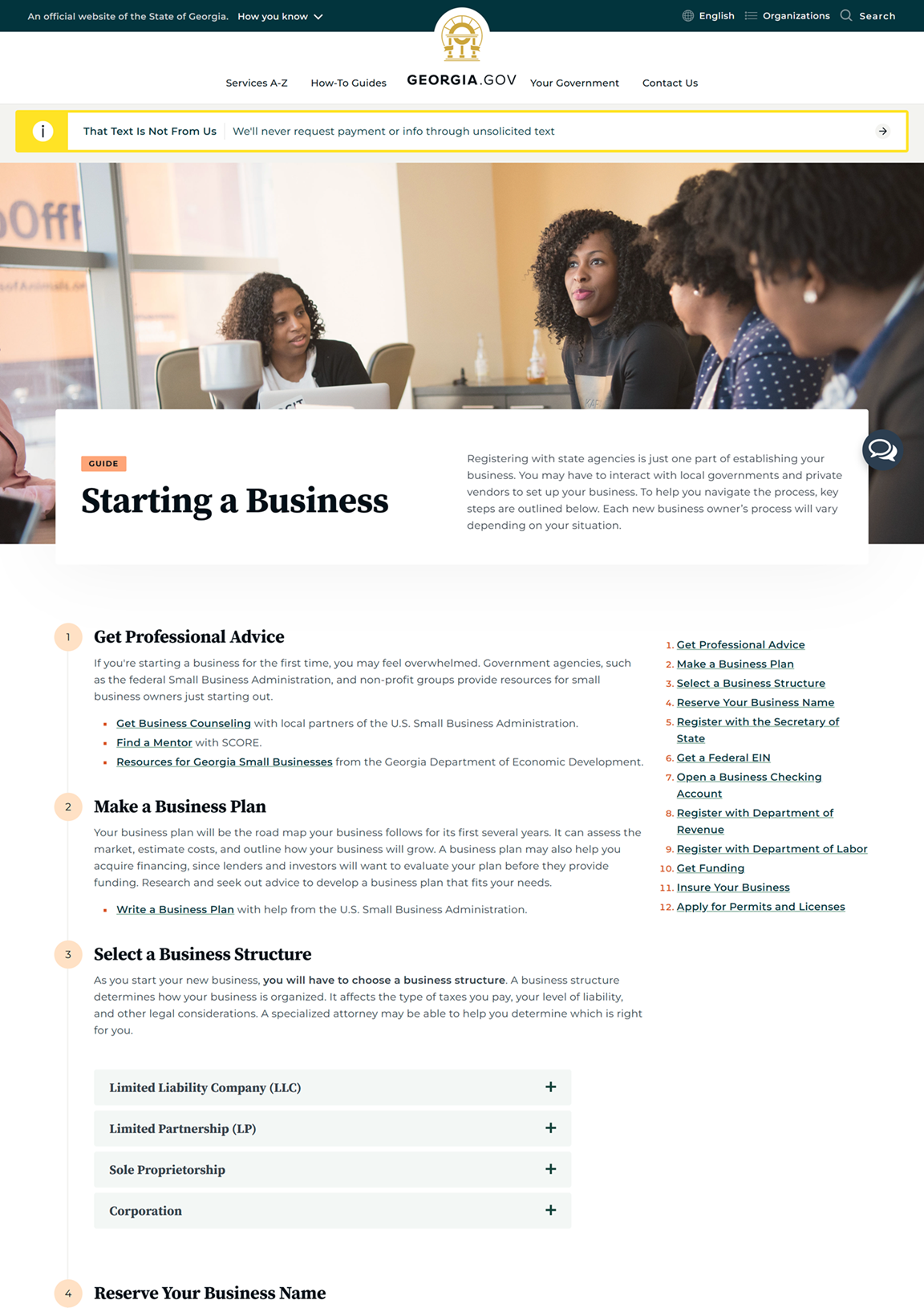
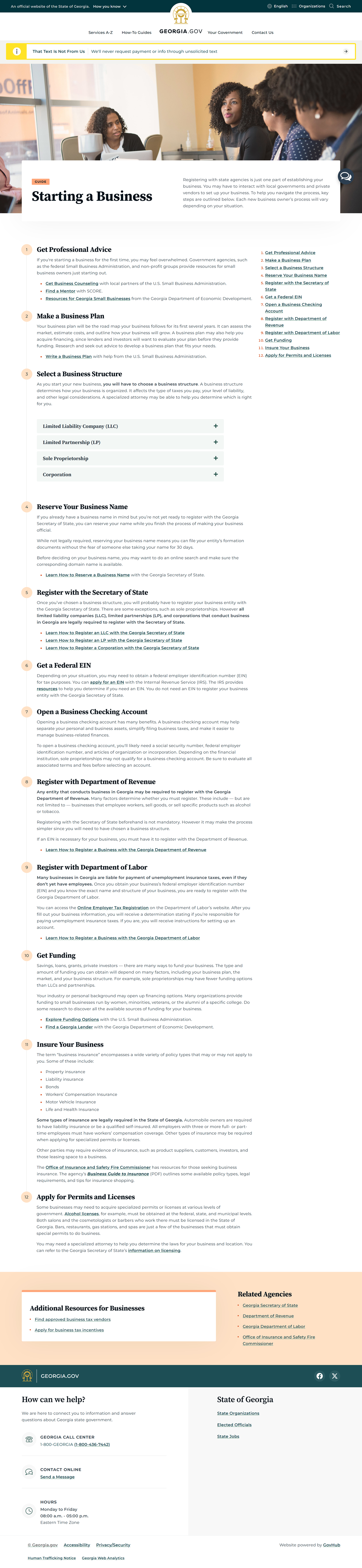
By the end, we had developed the only government one-stop resource for starting a new business in Georgia. Users can view the overall process, skip ahead to specific steps, expand sections to learn more, or click off to specific services for an in-depth look at how to accomplish that task (like registering with the Department of Labor). Each part of the guide can be easily edited or updated should processes or laws change.
Since publication, small business guide content has garnered nearly 2 million views, with close to 700,000 clicks on to carry out transactions at various agencies. Heat and scroll mapping showed interaction with content deep into the page, indicating interest in the full scope of the process.
We could reuse the custom content type we created for this guide to create other, similar guides on Georgia.gov. We’ve found it’s appropriate for complex, multi-step processes that require interacting with several agencies in a specific order. We used it to create our Moving to Georgia guide (which I also developed and wrote).
This is one of the many projects I’ve worked on that shows what you can accomplish when you gently redirect a client who is “solutioning”. So often, clients will come to us saying they want an app, a wizard, an AI chatbot, you name it. We ask them why and so often there is no clearly articulated, data-driven, user-based reason. So I always step back and ask, “what are you trying to accomplish?”
OPB and the governor’s office weren’t trying to build a wizard. They were trying to help people with fewer resources start a business. Once we started working toward that goal, the project looked a little different, but was much closer to what people actually needed.